Why Hire an Investment Bank

Why Business Owners Should Hire an Investment Bank for M&A Transactions
Selling a business, raising capital, or pursuing an acquisition are high-stake transactions that can have a significant impact on the business and its shareholders, management team, employees and customers. Deal processes are complex, the margin for error is small, and any misstep can be costly. Hiring an investment banking team to help navigate these complexities and mitigate the risks is often the smartest decision a business owner can make – and a decision that should come with a meaningful and measurable return on investment (ROI).
Key Benefits of Hiring an Investment Bank
The three primary tangible benefits to hiring an investment bank are:
- to maximize value,
- to increase the probability of closing, and
- to accelerate the speed-to-close.
Time is every deal’s worst enemy.
Clients often ask why they should hire an investment bank. Exceptional investment bankers can drive outcomes that far exceed their fee by enhancing valuation, deal structure, and strategic fit by multiples of the cost, ultimately generating an outsized ROI for the business owner. When challenged on this value proposition, Capstone’s response is simple: If our bankers don’t call you (most likely multiple times) during the transaction process to point to the payback value delivered, then don’t pay us. It has never happened.
There are also three critical intangible benefits that great banking teams provide:
- Immediate access to key decision makers among the most relevant strategic acquirers and/or private equity (PE) firms;
- A hedge against disruptions to the business, allowing owners and management teams to stay focused on growth and financial performance; and
- providing an important buffer layer between the company and its counterpart to protect relationships when sensitive conversations are needed.
This level of impact, both tangible and intangible, is why savvy business owners recognize the value of having the right advisory team. By way of example, Capstone’s founder (with 35 years of Wall Street deal experience) hired an investment bank when the firm was acquired in 2022 by Huntington (Nasdaq:HBAN) – for all the reasons stated above. He wanted to maintain his focus on engineering growth strategies, staying close to key customers, operating the business effectively, and managing people, communications, and culture. Beyond these priorities, he wanted to ensure that there were limited distractions to the business and exposure to potential confidentiality leaks – both which are also important considerations in hiring an investment bank.
As highlighted above, by hiring a professional team to run the deal process, the owner can continue to focus on running the business and hitting important financial targets, providing core stability throughout the transaction process. It is also important to have a buffer zone. The business owner cannot carry the flag in a fight against an acquiror or a PE investor (and there are many in each transaction). Investment bankers play a critical role in safeguarding the business owner’s legacy and future relationship with the new partner. Beyond securing the best financial outcome, they recognize that the owner has a life after the transaction—often involving new partners, ongoing relationships, and a personal reputation built over decades. A thoughtful banking team ensures that every step of the process is handled with discretion and care, working to protect and even enhance the owner’s standing, relationships, and long-term interests. There are a host of other reasons to hire an investment bank—deal process acumen, negotiation and structuring expertise, market and buyer intimacy, etc.—but they all tie into the first three points: maximizing value, increasing the probability of closing, and accelerating the speed-to-close.
Sure, having an investment banker is like having a guard dog when you need it, but what’s more important is that you have an evangelist.
Identifying Transaction Priorities
Most of Capstone’s clients have not been through a deal before, and it is often the only deal of this magnitude that they will experience. These deals are the owners’ legacies, not Capstone’s. The Capstone team is merely the architect of a desired outcome. Our investment bankers spend time up-front with the client to define what the ideal outcome looks like. This then serves as a “True North” framework to help guide the entire team throughout the deal. During the early preparation meeting, Capstone’s clients are typically given an exercise: develop a 10-point list of what the ideal transaction looks like. This list commonly includes points on valuation and structure. However, life after the deal followed by employee and customer care are typically the top concerns for business owners considering exit, according to Capstone’s Annual Middle Market Business Owners Report.
Capstone revisits the “nirvana” deal criteria several times during a transaction process as an owner’s priorities can shift along the way. This becomes especially important once the investment bankers begin hosting management meetings with potential acquirers or investors. It is used after every meeting as an ongoing grading scale so that everyone is compared on equal footing and can stay grounded in what defines a successful outcome. A business owner might meet with as many as 10 potential acquirers (or more) in an abbreviated period, either alone or with the broader management team. Having a formal framework in place that clearly defines what a “walk-off homerun” deal looks like becomes an important tracking and grading tool. While clients typically prioritize valuation, these other factors carry significant weight in the process as the final decision is often not made purely based on valuation.
Navigating Deal Complexities
The transaction environment is complex and dynamic. Every deal will encounter bumps in the road, and even “deal breakers”. Business owners rely on investment banks to help guide them through these hurdles, educate them, and help them make the right decisions. In an effort to de-risk transactions, there are several factors business owners should consider.
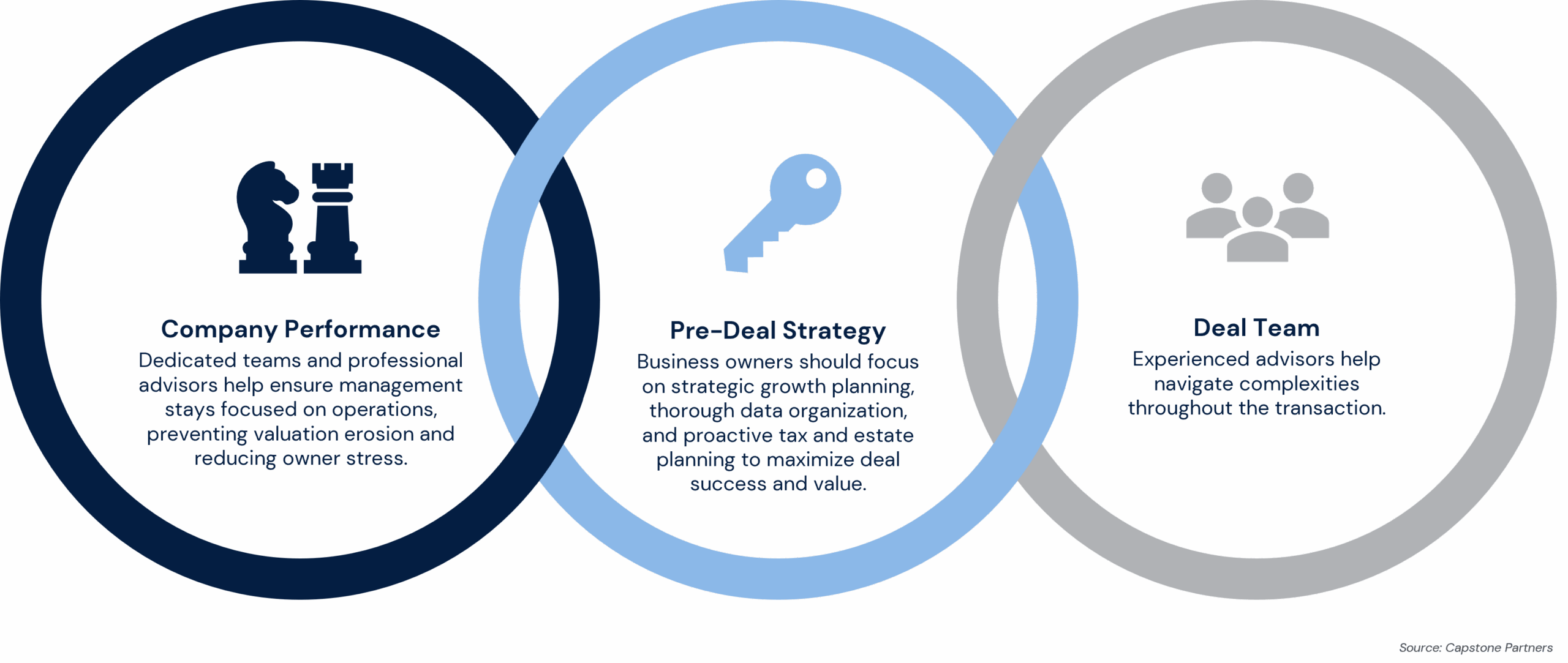
- Company performance is the leading challenge to any transaction. When company performance suffers during a deal process, it has a domino effect on valuation and structure. To combat this, Capstone staffs deals with large teams to enable management teams to focus on running the business rather than the transaction. Without professional representation, a business owner would likely face heightened stress/fatigue attempting to balance the transaction process and company operations simultaneously.
- Understanding the prerequisite action items before a transaction can be just as important as the execution of the transaction itself. Getting the company ready for a deal, including having an exciting growth strategy formulated, organizing data and documents, and engaging in tax and estate planning, are all aspects business owners should pay close attention to. Unfortunately, only a small minority of business owners have invested the requisite time and resources to properly prepare.
- Assembling the right team for the deal—from investment banker, to deal lawyer, to Quality of Earnings (QoE) and accounting support—is critical. Do it once. Do it right.
Three Key Points on the Road to a Successful Transaction
Investment Banks Utilize Relationships, Industry Knowledge to Create a Competitive Process and Drive Premium Valuations
Capstone has developed a robust buyer universe, cultivated over years of building trusted relationships with key strategic acquirers and PE firms across all industry coverage groups. This network is critical because a well-developed buyer pool not only increases competitive tension in a process but also ensures the right strategic and cultural fit is identified, and maximizes value, certainty of close, and long-term success for all stakeholders. Investment banking teams go into early meetings with a thesis on which parties are thought to be the best fit for a business. That opinion is based on a long history of dealings in prior transactions and ongoing discussions regarding current appetite. Capstone tends to be very transparent with buyer intelligence and tracks every buyer to learn about their behaviors during a transaction process, including valuation parameters and negotiation tendencies. Having an intimate knowledge of the buyer universe is important for any deal. It offers clients immediate access to the key decision makers and can increase both the speed and probability of closure. It is also a collaborative approach, sharing recommendations to the clients, and listening to the clients’ own ideas, history, and preferences on who they are willing to have participate in a transaction process. The buyer strategy is carefully vetted and approved by clients before investment banking teams begin to execute in the market. Having the right buyers in the mix is important for every deal. Without a formal process in place that creates competitive tension among the parties, the optimal deal will likely not be achieved.
When is the Right Time to Exit: Capstone’s Four-Pronged Test for Exit Readiness
Timing is everything. An investment bank can have the most sophisticated and well-developed deal strategy to present to a business, but if the timing is off something may be sacrificed in the transaction. Capstone tends to deploy a four-pronged approach in advising business owners about market timing. In the ideal situation, when timing is perfect for a transaction, these four elements are aligned.
Capstone’s Four-Pronged Exit Framework
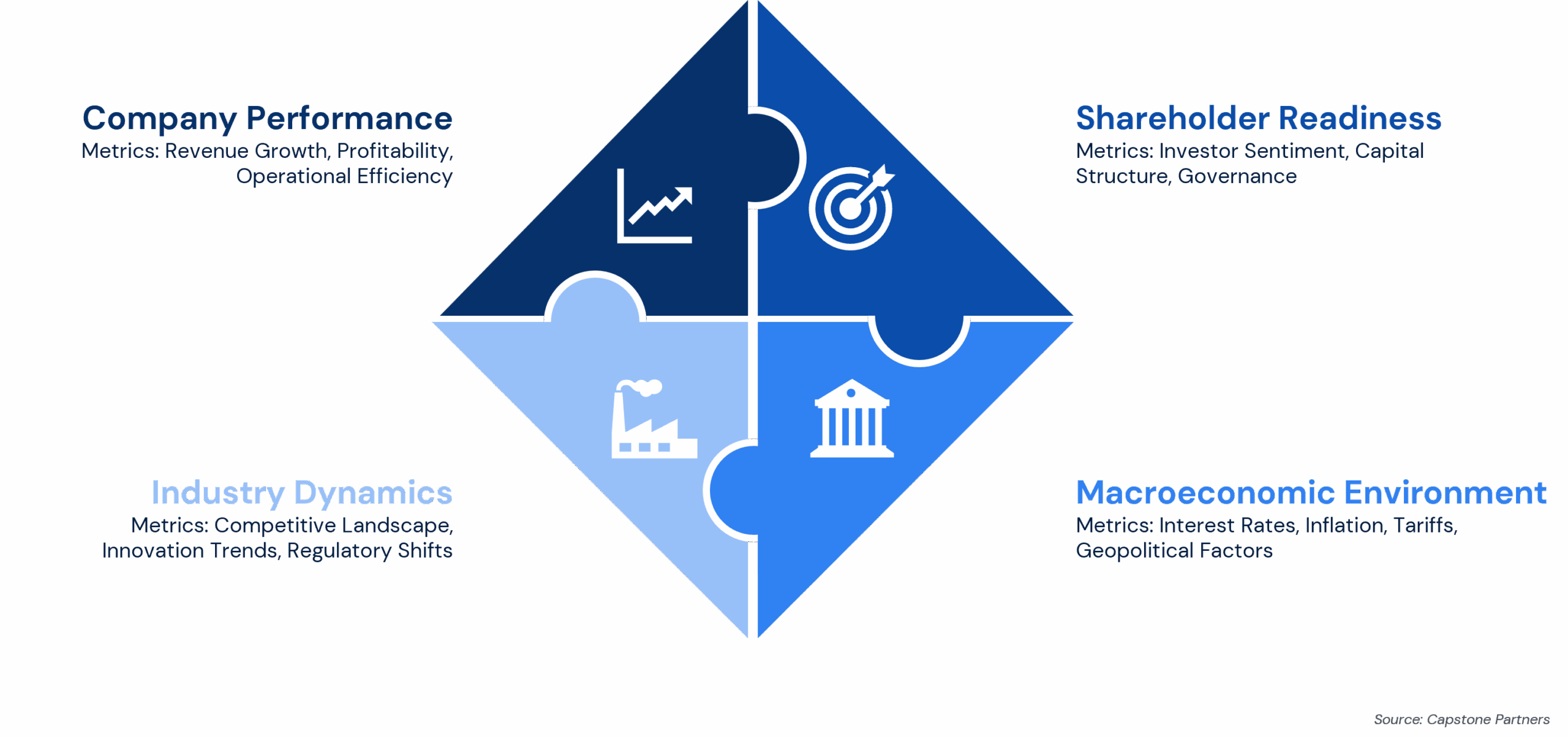
Capstone’s experience has been that when at least three of the four elements are in place, highly successful transactions occur. If at least three of these elements are not in place, it may be difficult to bring a deal to market. Often, the client is treated like a private company initial public offering (IPO), meaning the company is prepared for the deal markets, has conversations with the best-fit buyers, but holds off on making the call about launching a formal process until the firm is certain it can deliver on behalf of the client.
If a company goes to market in unfavorable conditions, and a deal is not consummated, it can result in damage to the business. Maybe it has become shop-worn, maybe the company is exposed to confidentiality issues, or maybe there is some level of deal fatigue. Whatever the result, the investment banker needs to spend as much time thinking about timing as they do about the rest of the transaction. It is that important.
What Makes Capstone Differentiated
Capstone’s primary differentiator is the quality and experience of our sector-specialized deal teams. Beyond that, there are two major attributes of Capstone that differentiate the firm from the competition.
- Built for the Middle Market – In Capstone’s primary target market, defined as $50 to $500 million deal size, the firm has positioned itself as a well-balanced solution for both business owners and PE investors. Business owners seek deep industry expertise and senior bankers to run a deal with a firm that has every capability needed to support a transaction. On smaller transactions, the larger Wall Street firms may not prioritize talent and resources. On the opposite end of the spectrum, the smaller boutique or regional firms lack the brand cache and broader capabilities that deals often require. Capstone has been built over the past 20 years to fill any void in the market—where an investment banking firm may be too large to gain proper attention, and another firm too small to bring the necessary resources and expertise to the table. Capstone is a national, publicly traded firm with 12 highly collaborative sector teams and vast resources to support every transaction. Simply put, clients get the best resources available on every transaction. We pride ourselves on being the “Goldilocks” solution for middle market business owners.
- Entrepreneurial Roots – Like our clients, Capstone is comprised of business builders and strategists, achieving 20%+ growth compounded annually since its founding in 2002. The firm has completed two rounds of growth equity, nine acquisitions, and became public when merged into Huntington in 2022. Beginning as a bootstrapped start-up with six people, Capstone’s experience naturally brings the firm closer to the clients. Not only does the firm understand the work and sacrifice that goes into building a business but also how critical every transaction is to clients’ businesses and their own personal legacy. Being entrusted as an investment banking advisor in these situations is both an honor and a huge responsibility. Capstone believes that history makes a difference in the quality of the transactions completed on clients’ behalf. Owners get expertise and brand strength from their advisor, wrapped with a layer of entrepreneurial grit, tenacity, and creativity. A tremendous recipe.
Capstone Partners offers a full suite of corporate finance solutions to help business owners achieve their goals. If you are considering a transaction to support the goals of your company and would like professional transaction guidance to help meet those goals, please contact us.
Insights for Middle Market Leaders
Receive email updates with our proprietary data, reports, and insights as they’re published for the industries that matter to you most.