Middle Market Business Owners Survey – 2026

Capstone Business Owners Research Survey Finds Exit Preparation Bolsters CEO Decision Making and Business Performance as Owners Acclimate to Volatility and Exhibit Optimism in 2026
Capstone Partners has released its 2026 Middle Market Business Owners Survey Report, with insights from privately-owned companies across the U.S. This report combines Capstone’s in-depth middle market knowledge with proprietary data obtained from 400 participating owners of privately held, middle market companies. Capstone surveyed middle market business owners across industries in the U.S. between May 20, 2026, and July 7, 2026. The full report, available for download below, evaluates the health and progress of the middle market in 2026, with sections including 1). State of Business & Decision Making, 2). Growth, Financial & Exit Planning, and 3). Revenue Impacts, Forecasts & Economic Outlook. The report also details the impacts of vertical alignment, exit preparation, and artificial intelligence (AI) adoption on middle market businesses in areas such as capital markets activity, inbound private equity (PE) interest, revenue growth, industry outlook, and economic outlook.
Growth Concerns Fall as CEO Operating Confidence Rises
Middle market business owners have showcased improved comfortability with persistent macroeconomic and geopolitical volatility in 2026. The share of CEOs concerned with company growth fell an average of 3.5% compared to 2025. Workload and stress concerns saw the largest decline, falling 8.8% year-over-year (YOY), followed by market demand (-7.5%), growth funding (-6.5%), and customer retention (-5.8%).
Rising confidence aside, company growth concerns have remained an operational headwind for more than half of all CEOs. For the fourth consecutive year, nearly all (92.3%) CEOs have ranked inflation as their top concern to company growth. Similarly, interest rates have remained the second-most growth concern for the third consecutive year, as noted by 83.8% of owners in 2026. Borrowing costs have been the only area where CEO concern has risen (+1.8%) amid expectations for rate hikes, which were later realized following the quarter percentage point increase on September 16th, 2026.
Business Owners’ Company Growth Concerns
(Share of CEOs that are somewhat or very concerned with factors impacting company growth)
Question: What factors most concern you when it comes to the growth of your company?
Source: Capstone Partners’ Middle Market Business Owner Survey, Total Sample Size (N): 401, 400
Owners Showcase Resilience Despite Sticky Trade Volatility
More than a year into the evolving tariff environment, middle market business owners have scaled back operational and strategic adjustments to adapt to shifting trade policy in 2026. Front-loaded operational modifications made in 2025 and supreme court rulings have mitigated tariff headwinds for business owners. However, newly announced tariffs circumventing these guardrails have kept trade policy growth concerns in place for the majority (69.3%) of surveyed CEOs.
Overall, most (79.5%) business owners have completed at least one tariff strategy shift in 2026, down 3.8% from 2025. Expense reductions (33.8%) and supply chain reconfigurations (25%) have remained the most popular tariff tactics, despite declining 5.9% and 9.2% YOY, respectively. Industry dynamics have continued to influence tariff mitigation tactics, with consumer-focused CEOs more likely to pass tariff costs onto customers while industrials businesses have utilized manufacturing nearshoring to avoid tariffs altogether.
Capital Markets Participation Expands Modestly
Middle market business owners have expanded their pursuit of capital markets transactions throughout 2026, albeit at a slowed growth rate compared to 2025. The majority (57.7%) of surveyed CEOs completed at least one capital markets transaction in the last 12-months (LTM), representing a 0.3% rise YOY. This marks a significant slowdown from 2025, which saw a 13.3% YOY increase in capital markets transactions.
As detailed in Capstone’s Capital Markets Update, the modest uptick mirrors expansion trends across the broader landscape, where transaction growth has diverged between small and large businesses. Among CEOs that completed at least one capital markets transaction in the LTM period, deal activity declined 0.4% YOY for businesses with less than $500 million in annual revenue. This represents a contrast to the 6.4% YOY growth seen among surveyed companies reporting $500+ million in annual revenue.
Majority of Middle Market CEOs Adopt AI Tools
Middle market business owners have been quick adopters of AI tools and solutions as they look for ways to enhance customer experiences and improve operational efficiency. The majority (84.5%) of surveyed CEOs reported that their business has already implemented or plans to adopt AI tools. Customer service/marketing AI solutions have represented the most common use case, as reported by almost half (49.4%) of CEOs utilizing AI.
Industries with relationship management needs—including Businesses Services and Healthcare—have been top adopters of AI customer service tools. AI deployment has been a strong indicator of business performance, with the share of business owners reporting any LTM revenue growth 39.3% higher among AI-enabled companies compared to those that have not already nor plan on adopting AI.
AI Adoption by Use Case
(Share of CEOs currently planning on using AI, by type)
Question: How does your company currently use or plan on leveraging AI in its operations?
Source: Capstone Partners’ Middle Market Business Owner Survey, Total Sample Size (N): 388
Inorganic Growth Strategy Plans Gain Traction
The lion’s share (48.8%) of business owners surveyed plan to execute growth strategies over the next 12-months (NTM), signifying a continued focus on efforts that bolster market share and scale. However, planned growth strategy initiatives have fallen 7.1% YOY, as recent inflationary pressures have seen owners increasingly prioritize financial stability. This pullback has been most pronounced across capital intensive organic initiatives; customer diversification plans have fallen 10.5% YOY while scheduled product/service line expansions have contracted 6.7% YOY.
Inorganic growth initiatives have become an increasingly utilized alternative to expedite expansion. Of note, 28.7% of CEOs have planned to raise equity capital over the NTM period (+1.5% YOY). M&A intent has also grown as owners have sought alternative methods to bolster scale, with both buy-side (+3.1%) and sell-side (+1.3%) engagement planning up compared to 2025. However, planned debt pursuits have fallen 4.9% YOY amid expectations for interest rate hikes.
CEOs Pursue Debt and Equity for Project Financing Needs
Capital intensive upfront costs associated with new strategic initiatives have pushed many middle market business owners to seek project financing support through debt capital or equity financing. Notably, project financing has represented the top use case for LTM debt capital (50%), NTM debt capital (57.1%), and NTM equity financing (44.6%) among surveyed CEOs.
Business Owners’ Debt Capital Usage
(Share of CEOs who raised/will raise LTM/NTM debt)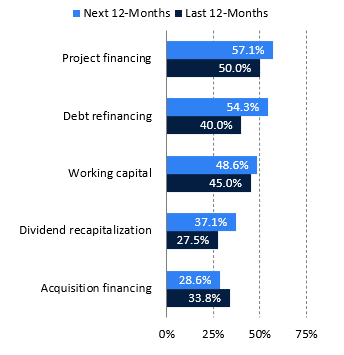
Question: For what purpose did you raise debt capital in the last 12 months?
For what purpose do you plan on raising debt capital over the next 12 months?
Source: Capstone Partners’ Middle Market Business Owner Survey, Total Sample Size (N): 80, 35
However, recent macroeconomic volatility and growing input cost pressures prompted business owners to prioritize working capital for general corporate purposes as their main use of equity financing in the LTM period. Complex capital markets deal proceedings have pushed many business owners to hire an investment banker; these CEOs have completed LTM debt (+19.1%) and equity financing (+16.7%) transactions at a higher rate than those without an advisor, demonstrating their added value.
Business Owners’ Equity Financing Usage
(Share of CEOs who raised/will raise LTM/NTM equity)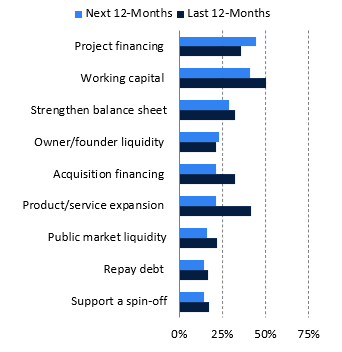
Question: For what purpose did you secure the equity financing in the last 12 months?
For what purpose do you plan on securing equity financing over the next 12 months?
Source: Capstone Partners’ Middle Market Business Owner Survey, Total Sample Size (N): 109, 56
Exit Preparation Drives Business Success, Creates Opportunities
Succession planning has decelerated amid recent market volatility, inflationary pressures, and potential interest rate hikes. In 2026, 72.7% of middle market CEOs have started preparing for an exit from their business. While this represents a 3.1% YOY decline, exit preparation activity in 2026 has remained meaningfully above the trough observed in 2024, suggesting a sizable pool of exit-ready business owners.
Our survey findings suggest a strong correlation between exit preparation and overall business performance. Compared to CEOs who have not started preparing for an exit from their business, exit prepared business owners completed more capital markets transactions in the LTM (+46.5%), attracted greater inbound PE interest (+34.5%), and reported greater LTM revenue growth (+20%). These results have showcased how strategic discipline associated with exit planning can often translate into stronger operational execution, efficient growth initiatives, and more proactive decision-making by CEOs.
Profile of a Well-Prepared Middle Market Business
(Among CEOs who have started to prepare for an exit from their business…)
Question: Which of the following business strategies have you enacted over the last 12 months?;
How has your revenue growth been impacted in the last 12 months?;
How often have you been contacted by private equity looking to buy your company?;
If you left the company, how confident are you that the business would remain viable a year from now?;
What revenue growth/change do you expect over the NTM? How would you describe your NTM industry outlook?
Source: Capstone Partners’ Middle Market Business Owner Survey, Total Sample Size (N): 291, 109
These benefits have become even more pronounced among business owners who have retained an investment banker, suggesting that professional advisory support not only improves transaction readiness and market visibility but has also helped middle market business leaders make more informed strategic decisions that drive operational success and growth. Notably, among CEOs with exit plans started, 79.4% feel confident in their business’ success one year after their departure—compared to just 60.6% who have not prepared. However, among business owners who have retained an advisor, 88.9% have expressed confidence in their business’ success one year after exiting. Investment banks offering M&A advisory services act as a partner to business owners; securing an advisor as early as possible is best practice, as proper M&A preparation can take two to three years.
U.S. Economic Outlook Reaches Four-Year High while Industry Outlook Remains Strong
Business owners have become more accustomed to market volatility, bolstering optimism for the NTM and encouraging a greater emphasis on growth-oriented initiatives. The share of CEOs with a very positive U.S. economic outlook has increased for the second consecutive year to 22.5% in 2026, marking a four-year high. A combined 50.3% of business owners in 2026 reported a very or somewhat positive outlook on the U.S. economy over the NTM period. This trend holds true beyond just the U.S. economy, with 56% of respondents sharing a positive outlook on the global economy and 60.3% expressing optimism within their local economies. However, inflation and interest rates have remained key concerns for business owners. The resolution of ongoing trade and geopolitical conflicts coupled with easing inflationary pressures will likely prove critical factor in maintaining CEOs upward outlook momentum.
Improved comfort with market volatility has also carried over to middle market business owners’ NTM industry outlook. The majority (71.6%) of CEOs have reported a positive NTM industry outlook, marking a 5.7% YOY improvement following two years of declining sentiment. Notably, the share of CEOs expressing a negative industry outlook has contracted, falling 4.2% YOY in 2026. Revenue expectations have mirrored this trend, with the share of CEO’s anticipating NTM revenue growth, climbing 3.2% YOY to 75.8%. NTM industry outlook has increasingly favored businesses with scale. Notably, 82.1% of business owners at large-sized companies (201+ employees) have conveyed a positive NTM industry outlook. This figure steps down as headcount drops—with 72.9% of CEOs at mid-sized (101-200 employees) and 61.7% at small-sized (1-100 employees) enterprises reporting a positive outlook over the NTM.
Business Owners’ Next Twelve-Month Industry Outlook

Question: How would you describe the outlook for your industry over the next 12 months?
Source: Capstone Partners’ Middle Market Business Owner Survey, Total Sample Size (N): 435, 404, 401, 400
We see this as important work, and we need your help. If you are the owner of a privately held company in the United States, we kindly ask you to volunteer for our study.
Sign up to participate in our study of U.S. Middle Market Business Owners and gain access to our 2026 report.

Download the Full Business Owners Survey Report Publication
Use this form to gain access to our full 2026 Middle Market Business Owners Survey, with an in-depth analysis of survey responses broken down by industry, and sign up to participate in our 2026 study:
Izzy Jack, Associate, was the lead Market Intelligence contributor to this report.
Insights for Middle Market Leaders
Receive email updates with our proprietary data, reports, and insights as they’re published for the industries that matter to you most.