Capstone Partners Completes Integration of Acquired TM Capital and Select Janney Teams, Unifying the Firm’s Growing Investment Banking Platform. Read More >
Restaurant M&A Ticks Up in Early 2026, AI Adoption Accelerates Amid Lagging Traffic
Capstone’s Restaurant M&A Report reports that turnaround activity, brand portfolio optimization, and privatizations have characterized the restaurant merger and acquisition (M&A) environment as operators contend with slow dining traffic and a muddied macroeconomic backdrop.
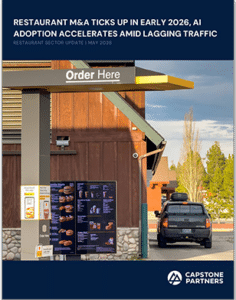
The deployment of artificial intelligence (AI) at the drive-through represents one of the most visible and transformative technological shifts in the Restaurant space. By automating order-taking, brands can reallocate labor, boost throughput, and programmatically drive larger check sizes. Beyond traditional drive-through applications, restaurant operators have increasingly integrated AI into their digital ordering ecosystems to streamline off-premise sales, mitigate language-related barriers, and create more interactive customer touchpoints. In loyalty programs, AI has enhanced hyper-personalized marketing by enabling real-time learning that can optimize customer lifetime value while protecting restaurant margins. In the back office, leading restaurant operators have aggressively deployed AI into their core kitchen and management operations to mitigate persistent labor constraints and improve throughput speed. By shifting focus toward real-time predictive analytics, these technologies protect four-wall margins by reducing food waste, preventing costly out-of-stock scenarios, and optimizing labor costs. Due to the increasing complexity of omnichannel ordering, operators have begun deploying AI directly into the preparation line to orchestrate ticket sequencing, monitor ingredient depletion, and automate physical food preparation. Together, these front- and back-office operational enhancements are anticipated to dictate winners and laggards in the Restaurant space. Initiatives related to technology and AI integration will likely support financial performances as the macroeconomic backdrop remains uncertain and serves as a cornerstone of acquirer diligence in M&A.
Restaurant M&A volume has remained strong to date, rising 42.9% year-over-year (YOY). Increased focus on debt reduction, asset-light operating models, and technology adoption has bolstered the volume of companies pursuing turnarounds, divestments of underperforming operations, and take-private transactions, bringing a larger pool of assets to market. Buyers have become more selective amid the abundance of available targets as holding periods for sponsor-backed companies have extended, resulting in a more buyer-friendly M&A market. However, high-quality businesses have continued to attract competitive bidding as buyers reentering the market have been motivated and well capitalized.
Strategic activity softened in 2025 but has held steady through year to date (YTD)—all being private company-led acquisitions. Strategic deals to date have skewed toward higher unit counts as buyers pursue selective, more impactful transactions for economies of scale, with the average acquired location count rising 54.4% YOY. In contrast to the cohort’s historical preference for franchisee acquisitions, strategic M&A to date has been evenly distributed across the Independent Brand, Franchisee, and Franchisor segments as buyers look for growth optionality and system-level influence. PE dealmaking has also notched a small increase in M&A activity YTD. Sponsors have favored acquisitions of operators with smaller footprints. Notably, 50% of PE M&A targets YTD have four to 10 locations. Prioritization of smaller operations is attributable to a shift in sponsor investments away from franchisors (54.3% of PE deals between 2020 and 2025 compared to 25% YTD) toward independent brands (20.7% of PE targets in 2020-2025 compared to 50% YTD).
“The Restaurant M&A market is in the early innings of a meaningful rebound. Buyers are well capitalized and increasingly decisive, but they are being selective, gravitating toward concepts with proven unit economics, defensible brand positioning, and clear paths to scale. At the same time, the current wave of take-privates, divestitures, and franchisee-led acquisitions is reshaping the ownership landscape in ways that create compelling opportunities for both sellers and acquirers across the middle market,” said Capstone Director Kenny Green, the lead contributor in the newly released report.
Also included in this report:
An analysis of traffic and same-store sales through February 2026 across the sector.
An overview of front-of-house and back-of-house technology and AI adoption across major restaurant brands.
Restaurant M&A details by buyer type, target unit count, and segment, including valuation analysis.
Capstone Partners’ Consumer Investment Banking Team provides M&A, capital formation, and financial advisory services to the owners of middle market businesses in the consumer and retail industries. Our team partners with leading mid-to-large sized restaurants that serve growing end-markets. For more information on the Restaurant M&A trends featured in this report or to speak with one of our Consumer Investment Banking Team members about how to grow, value, and/or sell your business, contact us today to start a conversation.