Capstone Partners Completes Integration of Acquired TM Capital and Select Janney Teams, Unifying the Firm’s Growing Investment Banking Platform. Read More >
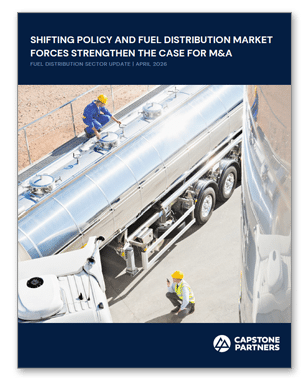
Shifting Policy and Fuel Distribution Market Forces Strengthen the Case for M&A
Capstone’s inaugural Fuel Distribution Market Update reports that the sector has remained a resilient and essential component of the broader Energy ecosystem, supported by stable, repeatable revenue streams and relatively inelastic end market demand. These characteristics, along with the sector’s largely service‑driven operating model and predictable cash flow profile, have made the space particularly well‑suited for strategic roll ups.
Competitive gaps have widened and larger operators have continued to build scale and sophistication—particularly in areas such as technology integration, loyalty programs, supply chain efficiency, and store‑level profitability. Smaller and mid‑sized companies have found it increasingly difficult to compete in this environment, as these advantages compound over time and erode the market share of less resourced operators. A similar dynamic has played out among companies with multi-line portfolios. Businesses that operate across several divisions—such as Wholesale Fuel, Propane, or Commercial Fuels—have reassessed where they maintain true competitive differentiation. For many, divesting non-core or underperforming divisions has become a practical strategy for reallocating capital and focusing on higher‑return business units. This trend of portfolio rationalization has continued to drive carve‑out and strategic acquisitions.
The policy landscape entering 2026 has become markedly more favorable for traditional energy businesses than in prior years, largely due to sweeping changes enacted through the One Big Beautiful Bill Act (OBBBA) legislation and additional administrative actions. Passed in July 2025, the OBBBA reinstated and permanently codified 100% bonus depreciation for qualified assets acquired in the year of purchase, according to the Internal Revenue Service (IRS).1 This change reversed the scheduled phase‑down of bonus depreciation and effectively enhanced the after‑tax economics of acquisitions. Buyers can now pay more for assets while still achieving equivalent returns, thereby directly supporting stronger valuations. The law also increased the gain exclusion associated with Qualified Small Business Stock, providing further incentives for owners considering an exit. Parallel to these tax reforms, the administration has implemented several energy policy shifts designed to support the domestic Non-Renewable Energy segment. These include eliminating electric vehicles (EV) mandates for automakers, removing EV tax credits, lowering fuel‑economy standards, and removing penalties associated with noncompliance. In the Upstream market, restrictions and regulatory burdens related to domestic oil output have eased, resulting in lower production costs and increased supply incentives. The cumulative effect of these changes is a policy backdrop that has reinforced the near‑term viability of traditional fuel demand and boosted sector confidence.
Also included in this report:
A breakdown on what type of buyers are targeting fuel distributors and what companies have willingly turned to asset roll ups as a faster, more efficient alternative to expanding market share organically.
Why sponsors have increasingly viewed propane distribution as an opportunity for operational transformation.
Analysis on notable transactions that have reshaped the Fuel Distribution landscape.
Capstone Partners’ Energy Investment Banking Team provides M&A, capital formation, and financial advisory services to the owners of middle market businesses in the Energy industries. Our team partners with leading mid-to-large sized Fuel Distribution businesses that serve growing end-markets. For more information on the Fuel Distribution market trends featured in this report or to speak with one of our Energy Investment Banking Team members about how to grow, value, and/or sell your company, contact us today to start a conversation.